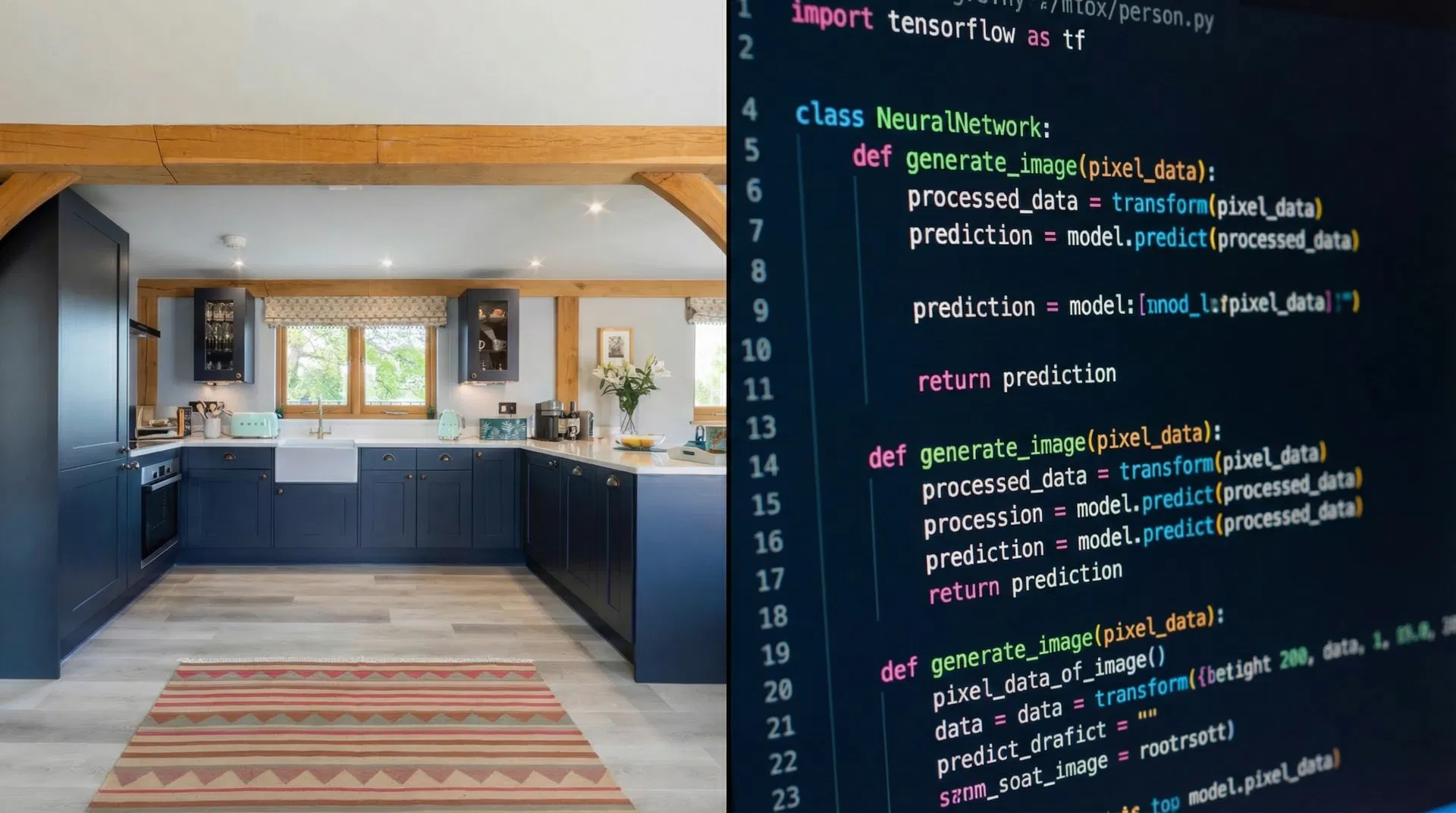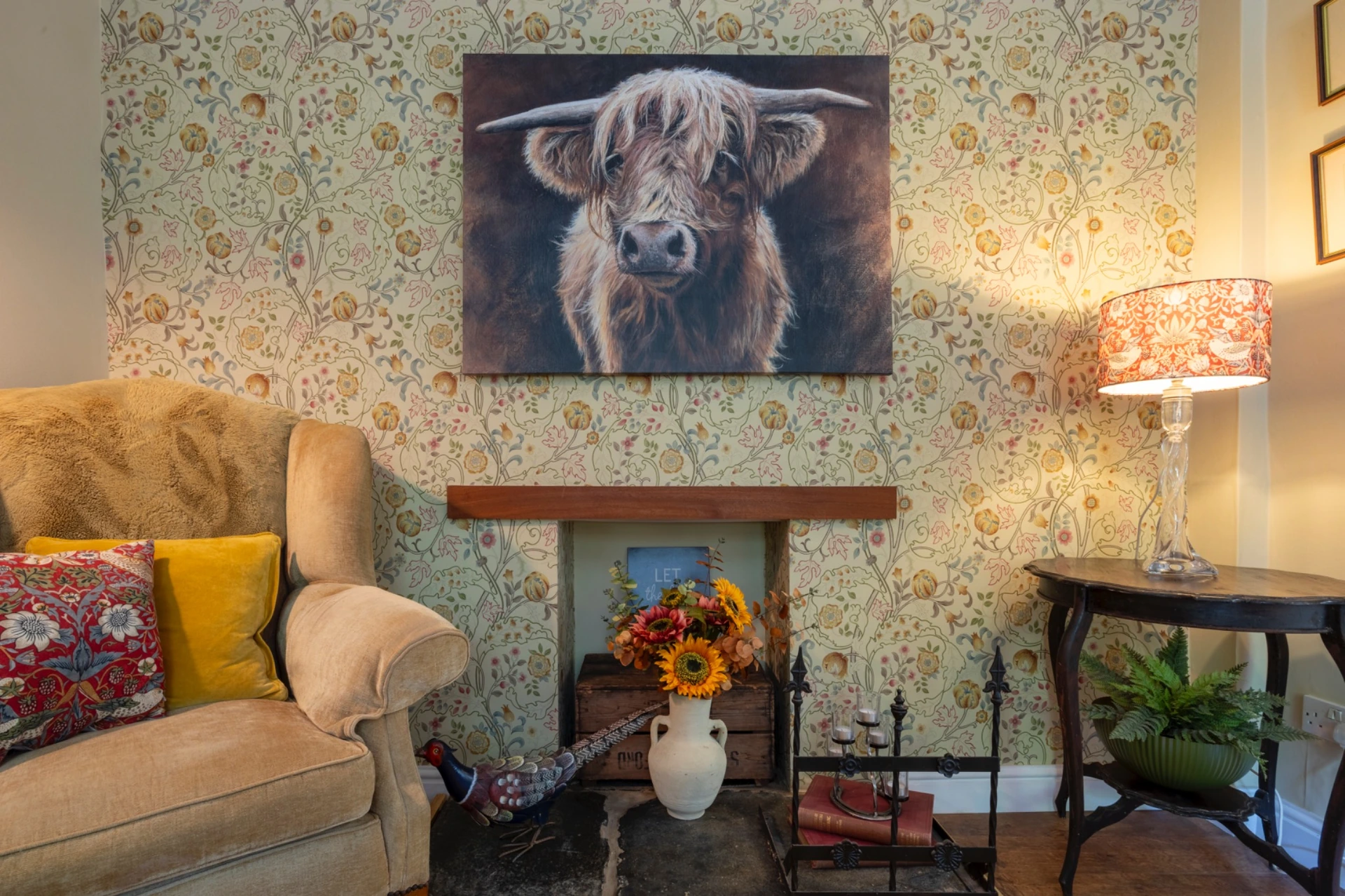
The way people search for properties is changing faster than most estate agents realise. In 2025, AI-powered search captured between 12 and 15 percent of global search share. Google's AI Overviews now reach over 2 billion users and appear on nearly half of all searches. ChatGPT, Perplexity, and Claude are increasingly the first place buyers go when they ask questions like "What does a three-bedroom cottage in Glastonbury look like?" or "Find me a property photographer near Taunton."
Here's the problem: these AI systems don't see your property photos the way a human does. They read the metadata — the alt text, the structured data, the file names, the schema markup. If that metadata is missing or generic, your images are effectively invisible to the fastest-growing search channels in the world.
This isn't a future concern. It's happening now. And the agents, photographers, and Airbnb hosts who understand image metadata are already pulling ahead.
01What Are Image Meta Tags?
Image meta tags are the hidden information attached to every image on a website. They tell search engines — and now AI systems — what the image shows, where it was taken, what it relates to, and how it should be categorised.
The most important image meta tags for property photography fall into five categories:
| Meta Tag | What It Does | Example |
|---|---|---|
| Alt text | Describes the image content for search engines and screen readers | "Professional HDR photograph of a modern kitchen with granite worktops and bifold doors opening onto a landscaped garden in Taunton, Somerset" |
| File name | Gives search engines a content signal before the image even loads | IMG_8545-taunton-kitchen-granite-worktops.webp |
| Title attribute | Provides additional context, often shown on hover | "Kitchen with garden views — 4-bed detached, Taunton" |
| Structured data | Machine-readable schema markup that tells AI exactly what the image represents | ImageObject with width, height, caption, and contentLocation |
| Open Graph tags | Controls which image appears when the page is shared on social media or cited by AI | og:image pointing to the hero property photo |
Think of it this way: a beautiful property photo without proper metadata is like a stunning house on a street with no name. Nobody can find it unless they already know exactly where to look.
02Why AI Search Engines Need Metadata
Traditional search engines like Google have always used image metadata as a ranking signal. But AI search engines depend on it even more heavily, because they don't just rank pages — they synthesise answers.
When someone asks ChatGPT "What does a professional property photo look like compared to an amateur one?", the AI doesn't browse Rightmove. It reads structured content from websites, interprets image metadata, and constructs an answer. If your property photography website has rich, descriptive alt text and proper schema markup, your images and your brand can appear in that answer. If your metadata is missing, you don't exist in that conversation.
Google's AI Overviews work similarly. When a buyer searches "best property photographer in Somerset," the AI Overview pulls information from multiple sources — including image metadata — to construct a summary. Google has confirmed that it uses three specific metadata methods to select which images appear in AI Overviews:
- 1.primaryImageOfPage schema markup — tells Google which image represents the entire page
- 2.mainEntityOfPage image properties — attaches the image to structured content like a BlogPosting or Service
- 3.og:image meta tag — the baseline signal that should exist on every page
Brands that appear in AI Overviews earn 35 percent more clicks than those that don't. That's not a marginal improvement — it's a competitive advantage that compounds over time.
03The Current State of Image Metadata (It's Bad)
Here's the uncomfortable truth: most property websites are doing this badly.
According to SE Ranking's 2025 analysis of websites across industries, only 26 percent of websites use alt text for their images. That means nearly three-quarters of all website images are invisible to AI search engines. In the property sector, where images are arguably the single most important content type, this is a significant missed opportunity.
I regularly audit estate agent websites and property listing pages, and the same problems appear again and again:
Generic or missing alt text. The most common issue. Images labelled "IMG_8545.jpg" or "photo1" or simply left blank. Every one of these is a wasted opportunity to tell AI search engines exactly what the image shows.
Duplicate alt text across all images. Some agents use the same alt text — often just the property address — for every single photo in a listing. This tells search engines nothing about what makes each image different. A kitchen photo, a garden photo, and a bedroom photo all labelled "3 Bed Semi, Taunton" are useless to an AI trying to understand your content.
No structured data. Very few property websites include ImageObject schema markup. Without it, AI systems have to guess what your images show based on surrounding text — and they often guess wrong.
Poor file names. Files uploaded straight from the camera with names like DSC_0042.jpg or IMG_1627.webp. These names carry zero semantic value. A file named "professional-drone-photo-somerset-cottage-aerial-view.webp" tells search engines exactly what to expect before the image even loads.
04How to Write Alt Text That AI Actually Uses
Writing good alt text for property photography isn't difficult, but it does require a shift in thinking. You're not writing for humans who can see the image — you're writing for machines that can't.
Here's my framework for property photography alt text:
Be specific about the room or feature. Don't write "living room" — write "spacious open-plan living room with exposed oak beams and wood-burning stove."
Include the property type and location. AI search engines are increasingly location-aware. "Modern kitchen in a four-bedroom detached house in Wells, Somerset" is far more useful than "kitchen photo."
Mention the photography technique when relevant. For specialist shots, include the method: "Twilight exterior photograph of a Georgian townhouse in Bath" or "Aerial drone photograph showing the property's half-acre garden and countryside views."
Describe what makes the image valuable. What would a buyer notice? "Bright south-facing master bedroom with floor-to-ceiling windows overlooking the Quantock Hills" paints a picture that AI can work with.
Here are some before-and-after examples:
| Before (Bad) | After (Good) |
|---|---|
| IMG_5675.jpg | Professional HDR photograph of a country kitchen with Aga range cooker and original flagstone flooring in a period cottage near Glastonbury, Somerset |
| Living room | Spacious double-height living room with gallery landing, inglenook fireplace, and views across the Somerset Levels |
| Exterior | Twilight photograph of a detached Victorian villa with illuminated bay windows and mature front garden in Clevedon, North Somerset |
| Drone shot | Aerial drone photograph showing a thatched cottage and its two-acre grounds surrounded by open countryside near Wedmore, Somerset |
| Bathroom | Contemporary family bathroom with freestanding copper bathtub, walk-in rainfall shower, and heated towel rail |
05Structured Data: The Metadata AI Loves Most
Alt text is the foundation, but structured data is what really makes your images stand out to AI search engines. Schema.org markup gives machines a precise, standardised way to understand your content.
For property photography, the most important schema types are:
ImageObject — wraps each significant image with metadata including URL, width, height, caption, and content location. This is what Google uses to select images for AI Overviews.
Photograph — a more specific type that identifies the image as a photograph rather than a diagram, illustration, or screenshot. Useful for distinguishing professional photography from floor plans or maps.
Place and PostalAddress — when attached to property images, these tell AI systems exactly where the property is located. This is critical for local search queries like "property photographer near me" or "houses for sale in Frome."
A well-structured property page might include schema markup like this:
```json { "@context": "https://schema.org", "@type": "WebPage", "primaryImageOfPage": { "@type": "ImageObject", "url": "https://example.com/images/taunton-cottage-exterior.webp", "width": 1200, "height": 675, "caption": "Professional exterior photograph of a period cottage in Taunton, Somerset" } } ```
This tells Google — and every AI system reading your page — exactly which image represents the page, what it shows, and where the property is located. Without this markup, AI systems have to make educated guesses. With it, they know.
06EXIF Data: The Hidden Metadata in Your Photos
Every digital photograph contains EXIF (Exchangeable Image File Format) data — metadata embedded by the camera at the moment the photo is taken. This includes the camera model, lens used, exposure settings, date and time, and often GPS coordinates.
For property photography, EXIF data serves several purposes:
Authenticity verification. In an era of AI-generated and heavily manipulated property images, EXIF data proves that a photograph was actually taken with a real camera at a real location. Some AI systems are beginning to use EXIF data as a trust signal.
Location confirmation. GPS coordinates in EXIF data can confirm that a property photo was taken at the address claimed in the listing. This is particularly relevant as AI search engines become more sophisticated about matching visual content to geographic queries.
Quality signals. EXIF data showing a professional camera body (like a Canon EOS R5 or Sony A7 IV) and a wide-angle lens signals to AI systems that the image is likely professional quality — not a phone snap.
However, there's an important privacy consideration. EXIF data can reveal the exact location where a photo was taken, which may not be appropriate for all property types — particularly Airbnb listings where the exact address isn't public. Professional photographers typically strip GPS data from delivered images while preserving other useful EXIF fields.
07Open Graph Tags: Controlling Your AI Presence
Open Graph (og:image) tags were originally designed for social media sharing — they control which image appears when you share a link on Facebook, LinkedIn, or Twitter. But they've become equally important for AI search.
Google has confirmed that og:image is one of the three metadata methods it uses to select images for AI Overviews and Discover. When an AI system cites your page in an answer, the og:image tag determines which visual appears alongside your content.
For property photography websites, this means every page should have a carefully chosen og:image that:
- Shows the best, most representative image on the page
- Is at least 1200 x 675 pixels (the recommended minimum)
- Is a real photograph, not a logo or generic graphic
- Has a descriptive file name and is served from a fast CDN
If you don't set an og:image, AI systems will pick an image for you — and it might be your cookie consent banner, a sidebar advert, or a tiny thumbnail that looks terrible at full size.
08What This Means for Estate Agents
Estate agents who optimise their property images for AI search will see measurable benefits:
More visibility in AI Overviews. When a buyer asks Google "What should I look for in a property in Bridgwater?", agents with properly tagged images are more likely to appear in the AI-generated answer — complete with a thumbnail of their best listing photo.
Better performance on portals. Rightmove and Zoopla are both investing in AI-powered search features. Listings with rich metadata will surface more prominently as these features roll out.
Stronger brand presence in AI assistants. When ChatGPT or Perplexity recommends a property photographer or estate agent, it draws on structured data and image metadata to construct its answer. Agents with comprehensive metadata are more likely to be cited.
Future-proofing. AI search is growing rapidly — from 12 percent of global search in 2025 to an estimated 25 percent by 2027. Investing in image metadata now builds a foundation that will pay dividends as AI search becomes the norm.
09What This Means for Airbnb Hosts
For holiday let owners and Airbnb hosts, image metadata is equally critical:
Listing discovery. When a traveller asks an AI assistant "Find me a cosy cottage in the Mendip Hills with a hot tub," the AI searches for content that matches. If your listing photos have alt text mentioning "cosy cottage," "Mendip Hills," and "hot tub," you're far more likely to appear in the answer.
Review and recommendation engines. AI-powered travel recommendation tools are emerging rapidly. They read your listing content, your reviews, and your image metadata to build a picture of your property. Rich metadata helps them recommend your property accurately.
Direct booking visibility. If you have your own booking website (rather than relying solely on Airbnb), proper image metadata helps AI search engines find and recommend your property directly — potentially saving you the platform commission.
10A Practical Checklist
Here's what you can do today to improve your property image metadata:
- 1.Audit your current alt text. Open your website, right-click any property image, and select "Inspect." Look for the alt attribute. If it's empty, generic, or just a file name, it needs fixing.
- 1.Rename your image files. Before uploading, rename files from camera defaults to descriptive names: "taunton-period-cottage-kitchen-aga.webp" not "IMG_8545.webp."
- 1.Write unique, descriptive alt text for every image. Use the framework above: room/feature + property type + location + what makes it special.
- 1.Add og:image tags to every page. Choose the single best image on each page and set it as the og:image. Include width and height attributes.
- 1.Implement ImageObject schema markup. Start with your homepage and key service pages, then extend to blog posts and portfolio pages.
- 1.Check your EXIF data. Ensure professional photos retain camera and lens information while stripping GPS data where privacy is a concern.
- 1.Test your markup. Use Google's Rich Results Test (search.google.com/test/rich-results) and the Schema.org Validator (validator.schema.org) to verify your structured data is correct.
11Why Professional Photography Makes This Easier
One of the underappreciated benefits of working with a professional property photographer is that metadata optimisation becomes part of the workflow. When I deliver images, every file is named descriptively, EXIF data is preserved (with GPS stripped for privacy), and I can provide alt text suggestions based on what each image actually shows.
Amateur photos — whether taken on a phone or by someone without property photography experience — rarely come with any of this. The file names are camera defaults, the EXIF data may be stripped entirely by messaging apps or social media uploads, and there's no thought given to how search engines will interpret the images.
Professional photography isn't just about making a property look good. It's about making a property findable — by humans browsing Rightmove, by Google's traditional search, and increasingly by the AI systems that are reshaping how buyers discover properties.
12The Bottom Line
AI search is not replacing traditional search — it's layering on top of it. Buyers now discover properties through Google, through AI Overviews, through ChatGPT conversations, and through AI-powered features on Rightmove and Zoopla. Each of these channels relies on image metadata to understand, categorise, and recommend your content.
The agents and hosts who invest in proper image metadata today are building visibility across every search channel simultaneously. Those who ignore it are leaving their best marketing asset — their property photography — invisible to the fastest-growing discovery channels in the world.
It takes a few minutes per image to get the metadata right. The return on that investment compounds every single day.